Miami Businesses Losing Cyber Insurance in 2026 Without IT
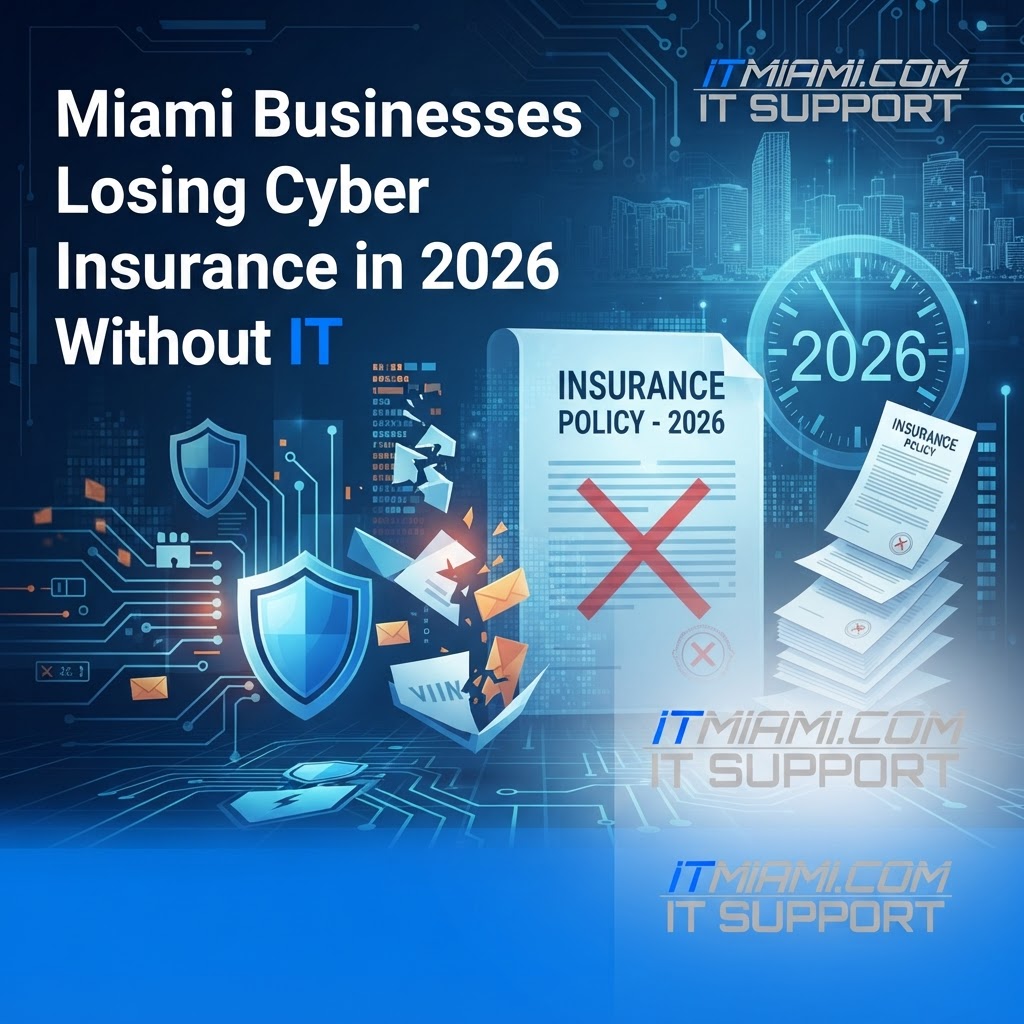
Miami Businesses Losing Cyber Insurance in 2026 Without IT
Your Miami business just received a cyber insurance renewal notice — and buried in the fine print are new technical requirements your current setup almost certainly doesn't meet. Without qualified managed IT services Miami businesses trust to maintain compliance, insurers are quietly denying renewals, slashing coverage limits, or doubling premiums for South Florida companies that can't prove they have active endpoint protection, multi-factor authentication, and documented security policies in place. That's not a warning about 2030. It's happening right now, in 2025, to businesses exactly your size.
For Miami companies running between 5 and 50 computers, losing cyber insurance isn't just an inconvenience — it's an existential financial threat. One ransomware attack, one data breach, one disgruntled employee clicking the wrong link, and you're absorbing six-figure losses completely out of pocket. South Florida's business environment is competitive and unforgiving. You cannot afford to operate exposed. Let's break down what's really at stake.
Cyber Insurance Requirements Have Changed — And Most Miami Businesses Don't Know It
If you purchased a cyber insurance policy two or three years ago and haven't reviewed it since, you may be operating under a dangerous illusion of protection. Insurance carriers have overhauled their underwriting requirements heading into 2026, and the technical controls they now demand — multi-factor authentication, endpoint detection and response, documented patch management, and encrypted backups — are non-negotiable. Businesses that can't prove these controls are in place are either being denied coverage outright or discovering their claims are rejected after an incident occurs.
A Brickell-based accounting firm recently learned this lesson the hard way. After a ransomware attack locked their client files for eleven days, they filed a claim expecting their policy to cover recovery costs. The insurer denied it — citing a gap in MFA enforcement across their email platform, a requirement buried in the fine print of their renewed policy. The firm paid over $80,000 out of pocket. That scenario is playing out across Miami right now, in medical offices in Doral, law firms in Coral Gables, and logistics companies in Kendall. The requirement changed. The business didn't.
The first step is a formal compliance gap assessment — a detailed audit that maps your current security posture against what your insurer actually requires. iTMIAMI performs these assessments for Miami businesses with five to fifty computers and delivers a clear, prioritized action plan. You cannot fix what you haven't measured, and you cannot afford to wait until renewal time to find out you don't qualify.
The Real Cost of Losing — or Being Denied — Cyber Coverage in Miami
Cyber insurance exists because the financial exposure from a single breach can be existential for a small business. The average cost of a data breach for a company under 500 employees now exceeds $3.3 million when you factor in downtime, legal liability, regulatory fines, and reputational damage. For a Miami Beach boutique hotel or a Coral Gables medical practice, that number doesn't represent a setback — it represents closure. Without valid, enforceable coverage, every day your business operates is a day you're self-insuring against catastrophic risk.
What makes the 2026 landscape especially dangerous is that insurance companies are auditing more aggressively at claims time, not just at application time. A Miami Beach marketing agency recently discovered their policy had a clause requiring quarterly vulnerability scans with documented remediation. They had never performed a single one. Their insurer is currently disputing a $140,000 social engineering claim on those grounds. The policy existed on paper. The protection did not exist in practice.
iTMIAMI works with Miami businesses to maintain continuous compliance — not just checkbox compliance at renewal time. That means automated documentation, regular scanning, and proof-of-control reporting that holds up to insurer scrutiny when it matters most. This is what separates active protection from false security.
What Cyber Insurers Are Actually Requiring in 2026 — A Technical Breakdown
Insurance underwriters have become sophisticated technical evaluators. In 2026, most mid-market carriers are requiring: MFA on all remote access and email, EDR software on every endpoint, immutable offsite backups tested at minimum quarterly, a documented incident response plan, privileged access management, and employee security awareness training with records. Meeting one or two of these is no longer sufficient. Carriers want the full stack, and they want documented evidence that each control is actively managed.
For a Doral distribution company with thirty workstations and a mix of Windows and mobile devices, standing up these controls without professional guidance is genuinely complex. The configuration details matter — an MFA implementation that excludes legacy applications creates a gap that voids coverage just as completely as having no MFA at all. Partial compliance is treated the same as non-compliance when a claim is filed.
iTMIAMI's technicians are on the ground in Miami, familiar with the specific technology environments that local industries rely on, and available around the clock when configurations need to change or an insurer requests updated documentation. A remote firm in another state cannot walk into your Kendall office the next morning. iTMIAMI can — and does.
Why a Local Miami IT Partner Gives You a Compliance Advantage No Remote Firm Can Match
There is a fundamental difference between a managed IT provider who knows your business because they've been inside your building and one who only knows you as a ticket number in a queue. Cyber insurance compliance is not a one-time project — it's an ongoing operational discipline that requires someone who understands your specific environment, your staff's behavior, your vendor relationships, and your risk profile. A faceless remote helpdesk cannot build that understanding, and that gap shows up directly in your compliance documentation.
Consider a Coral Gables law firm that switched to a national remote-only IT provider to save money. When their cyber insurer requested updated evidence of endpoint protection coverage during a mid-term audit, the remote provider took nine days to compile the report — and it contained gaps because two attorney laptops had been replaced without being properly enrolled in the management platform. The insurer issued a coverage warning. That kind of visibility gap simply doesn't happen when your IT team has eyes on your environment consistently and locally.
iTMIAMI is a Miami IT company serving Miami businesses — not a call center routing your concerns to a technician who has never seen your office. Our team provides on-site response, local account management, and 24/7 monitoring specifically calibrated for the industries and regulations that affect businesses in South Florida. When your insurer asks a hard question, we have the answers ready because we've been managing your environment, not reacting to it.
How iTMIAMI Prepares Miami Businesses to Meet — and Maintain — 2026 Cyber Insurance Standards
Getting cyber insurance compliant is a process, and maintaining it is a discipline. iTMIAMI approaches this in three phases for every client: assess, implement, and document continuously. The assessment identifies every gap between your current environment and your insurer's stated requirements. The implementation phase deploys and configures the controls — MFA, EDR, backup systems, access management — correctly and completely. The documentation phase ensures that every control generates the evidence trail your insurer needs if a claim ever occurs.
A Kendall-based healthcare services company came to iTMIAMI after their renewal premium increased by 60% due to a poor security questionnaire response. Within ninety days, iTMIAMI had deployed a complete compliant stack, documented every control, and supported them through a carrier re-evaluation. Their premium came back down, their coverage improved, and they now have active protection instead of a policy that could be contested. That outcome is repeatable — because the process is disciplined and local.
If you own or operate a Miami business with five to fifty computers and you are not certain your current IT environment meets 2026 cyber insurance requirements, the time to act is now — not at renewal, and certainly not after an incident. Contact iTMIAMI today for a cyber insurance compliance assessment and find out exactly where you stand before your insurer does.
Cyber insurance requirements in 2026 are not suggestions — they are gatekeepers standing between your Miami business and financial ruin after an attack. Every day you delay getting compliant is another day your coverage can be denied when you need it most, leaving you exposed to devastating losses your competitors won't survive. iTMIAMI specializes in helping Miami businesses with 5 to 50 computers meet every technical requirement insurers demand, so you gain real coverage and real peace of mind — not just a policy that falls apart at claim time. Don't wait for a crisis — call (305) 900-2601 now for a free IT consultation. Prefer to talk on your schedule? Book a free 15-minute discovery call here.
Related Services
Need Expert IT Support?
Schedule a free 15-minute consultation with our Miami IT experts. No obligation, just honest advice for your business.